How Veterinary Technology Can Reduce Front-Desk Burnout Without Losing the Human Touch
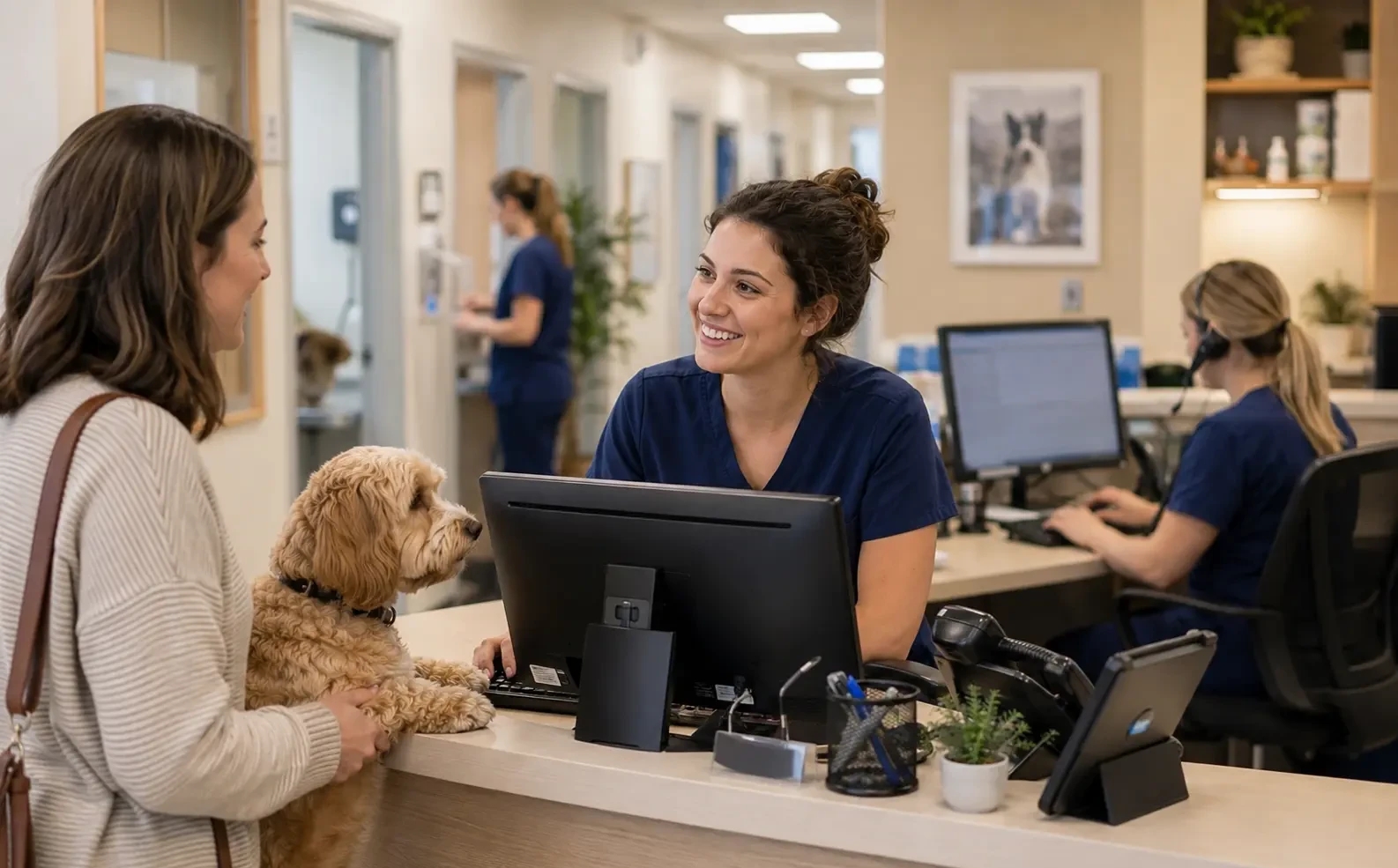
Running the front desk of a veterinary hospital is far more complex than answering phones and checking clients in. Receptionists and client service representatives often serve as the communication center of the entire practice. They answer appointment requests, respond to worried pet owners, coordinate schedules, communicate with veterinary teams, manage cancellations, handle routine questions, and keep daily operations moving.
When a practice becomes busy, these responsibilities can quickly pile up.
A receptionist may be helping a client standing at the counter while another client is waiting on the phone, an appointment request arrives online, a veterinarian needs information about the next patient, and someone else is trying to reschedule an appointment. Even an experienced team can become overwhelmed when multiple communication channels demand attention simultaneously.
Technology can help veterinary practices address this challenge, but the goal should not be to remove human interaction from veterinary care. Instead, technology should handle repetitive administrative work so staff can devote more attention to conversations that genuinely require empathy, judgment, and personal service.
For modern veterinary hospitals, finding that balance can be an important step toward creating a healthier workplace and a more consistent client experience.
Why the Veterinary Front Desk Is Under So Much Pressure
Veterinary reception teams operate in an environment where interruptions are normal. Unlike many conventional offices, veterinary hospitals rarely have completely predictable days. Routine wellness visits may be scheduled alongside urgent appointment requests, prescription questions, postoperative concerns, new-client inquiries, and last-minute cancellations.
Each interaction requires attention. The difficulty is that many administrative tasks happen at the same time. Consider a typical busy morning. A pet owner calls to book a vaccination appointment. Another wants to know the hospital's hours. Someone needs to change an existing appointment. A new client wants directions. Another pet owner has a question that needs to be passed to the clinical team.
Individually, these tasks may take only a few minutes. Collectively, however, they can consume a significant portion of the front desk's day. The result is not simply a busy phone line. Constant task switching can make it harder for employees to focus, document information accurately, communicate consistently, and provide clients with the level of attention they expect.
Administrative Work Can Pull Staff Away From Clients
One of the biggest challenges in veterinary practice management is deciding where staff time provides the greatest value.A receptionist's communication skills are especially valuable when a pet owner is worried, confused, frustrated, or trying to understand what happens next. Those conversations benefit from patience and personal attention.
But should that same employee need to manually answer every routine question about business hours?
Should staff spend valuable time repeatedly confirming appointments?
Should they have to stop an in-person conversation every time the phone rings?
When routine administrative work consumes too much of the day, veterinary employees have less time for higher-value interactions. This is where thoughtfully implemented veterinary technology can make a meaningful difference.
Automation Should Support Staff, Not Replace Them
There is sometimes a misconception that introducing AI and automation means eliminating human communication. For veterinary practices, the more useful approach is augmentation rather than replacement.
Technology can be assigned predictable, repetitive tasks while employees remain responsible for interactions requiring clinical judgment, emotional intelligence, exceptions, or complex decision-making.
For example, a digital system may help with appointment requests, reminders, routine inquiries, call routing, and documentation. A staff member can then focus on a client whose pet has a complicated history or whose request cannot be handled through a standard workflow.
The distinction matters.
Veterinary medicine is built around relationships and trust. Technology works best when it protects the time required to maintain those relationships.
24/7 Communication Can Reduce the Morning Rush
One common source of front-desk pressure is accumulated after-hours demand. Pet owners do not necessarily think about veterinary appointments only during hospital hours. They may remember at 9:30 p.m. that their dog needs a wellness visit or realize on Sunday that they need to arrange an appointment during the coming week.
If the only option is calling when the hospital opens, those requests can accumulate.
The result may be a wave of calls during the first hour of the morning. Providing digital or automated ways to handle appropriate appointment requests outside normal hours can spread that administrative demand across the day rather than concentrating it at the front desk.
MyVetHub, for example, provides an Appointment Manager designed to support 24/7 online booking, automated SMS and email reminders, and multi-provider scheduling.
The purpose of tools like these is not merely convenience for pet owners. They can also reduce the number of repetitive scheduling interactions that employees must manually process.
Smarter Phone Workflows Can Reduce Constant Interruptions
The telephone remains one of the most important communication channels for veterinary practices. It can also be one of the most disruptive.
A ringing phone does not know that the receptionist is already helping someone. It does not know that three people are waiting at the counter or that another employee is trying to finish an important task.
Traditional phone workflows often force staff to react immediately. Modern communication systems can make the process more manageable. Intelligent routing can direct calls more appropriately. Automated handling can assist with suitable routine inquiries. Call summaries can help employees understand what happened without requiring them to replay an entire conversation. Missed-call workflows can help prevent inquiries from simply disappearing.
MyVetHub's AI-powered VoIP system is designed around these types of capabilities, including intelligent routing, call summaries and transcripts, AI-assisted follow-up, and multi-device support. When communication is organized more effectively, employees can spend less time figuring out what happened and more time addressing what actually needs attention.
Appointment Management Should Reduce Work, Not Create More Work
Scheduling sounds straightforward until a practice manages multiple veterinarians, appointment types, procedures, urgent cases, cancellations, and changing client availability. A poorly designed scheduling process can generate additional work.
For example, if clients cannot conveniently request appointments online, they call. If reminders are inconsistent, staff may need to make confirmation calls. If cancellations are not handled efficiently, valuable appointment slots may remain unused.
A better scheduling system reduces the number of manual steps. Online booking gives pet owners greater flexibility. Automated reminders help keep upcoming appointments visible.
Centralized multi-provider scheduling makes it easier for staff to understand availability.
The objective is to make scheduling a workflow that operates continuously instead of a task that requires constant front-desk intervention.
Documentation Is Another Hidden Source of Workload
Administrative pressure does not end when an appointment begins. Veterinary professionals also need accurate documentation. Consultation notes, client instructions, medical histories, follow-up information, and internal communication all contribute to the administrative workload of a practice.
When veterinarians spend extra time finishing records, other work can shift toward support staff or extend the workday.
AI-assisted transcription offers another opportunity to reduce repetitive administrative work.
MyVetHub's AI Transcribe solution is designed to convert veterinary conversations into structured documentation and SOAP notes while recognizing veterinary terminology.
The broader lesson is important: reducing burnout requires examining the entire workflow, not simply the reception desk. A bottleneck in one part of a veterinary hospital often creates pressure somewhere else.
Better Information Flow Reduces Repeated Questions
One overlooked source of workplace frustration is having to find the same information repeatedly. A client calls. One employee speaks with them. Later, another employee needs to understand what was discussed. Someone searches through notes or asks a coworker. The client calls again and has to repeat the story.
This creates unnecessary friction for both clients and staff. Centralized communication histories, transcripts, summaries, and connected workflows can improve continuity. Employees should be able to understand previous interactions quickly enough to continue the conversation without starting from zero.
This can be particularly valuable in busy multi-provider practices where several team members may interact with the same client.
Technology Can Protect Time for Empathy
The strongest argument for automation in veterinary practices is not simply speed.
It is attention. Pet owners sometimes contact a veterinary hospital during stressful moments. Their pet may be sick, recovering from a procedure, behaving unusually, or experiencing a problem they do not understand.
Those conversations deserve attention. If employees are simultaneously trying to process routine scheduling requests, manually confirm appointments, and answer basic administrative questions, it becomes harder to provide that attention consistently.
Automating predictable tasks creates more room for meaningful human communication.
In that sense, technology can actually help veterinary practices become more personal rather than less personal.
Implementation Matters
Adding technology alone will not automatically reduce employee stress. Poorly implemented software can create new problems, including duplicate workflows, unnecessary notifications, confusing interfaces, and additional training requirements.
Practices should therefore evaluate technology based on how well it fits existing operations.
Before adopting a new solution, veterinary leaders should identify which tasks consume the most staff time.
- Is the biggest problem missed calls?
- Is scheduling creating repeated interruptions?
- Are appointment confirmations taking too much time?
- Is documentation extending the workday?
Are employees repeatedly transferring information between disconnected systems?
Once the underlying problem is clear, practices can choose technology that addresses that specific source of friction.
Measure the Effect on the Team
Veterinary technology should ultimately produce measurable operational improvements.
Practices can monitor factors such as call volume handled manually, average response time, appointment booking patterns, missed calls, scheduling workload, documentation time, and client response rates.
Employee feedback is equally valuable. Ask front-desk employees which tasks feel easier after implementation and which processes remain frustrating. Technology decisions should not be based solely on features. They should be based on whether those features make the practice easier to operate.
The Future Front Desk Is Human and Technology-Assisted
The future of veterinary practice management is unlikely to be entirely manual or entirely automated. It will be a combination of both. AI and automation are particularly effective at handling repetitive processes, organizing information, supporting appointment management, documenting conversations, and maintaining communication outside conventional working hours.
Veterinary professionals remain essential for judgment, empathy, relationship-building, complex problem-solving, and patient care. Practices that understand this distinction can use technology strategically.
Instead of asking, “How can we automate our front desk?” a better question is:
“How can we remove unnecessary administrative work so our front desk team can focus on the interactions where people matter most?” That shift in thinking creates a healthier approach to digital transformation.
Building a More Sustainable Veterinary Practice with MyVetHub
Veterinary teams entered the profession to help animals and the people who care for them. Yet growing administrative demands can gradually consume the time and energy that should be dedicated to those relationships. MyVetHub is designed to help veterinary hospitals reduce that operational friction through connected technology.
From AI-powered VoIP communication and VERA, the 24/7 AI receptionist, to appointment management, AI-assisted transcription, veterinary websites, and digital marketing solutions, MyVetHub helps practices modernize repetitive workflows while keeping meaningful human communication at the center.
The goal is not a veterinary hospital without people. It is a veterinary hospital where people have more time to do the work that requires them.
By allowing technology to handle suitable administrative tasks, practices can create more focused teams, smoother client experiences, and a more sustainable working environment for the professionals who keep veterinary hospitals running.