
Infection Control Starts at the Front Desk: A Protocol Guide for Veterinary Practices
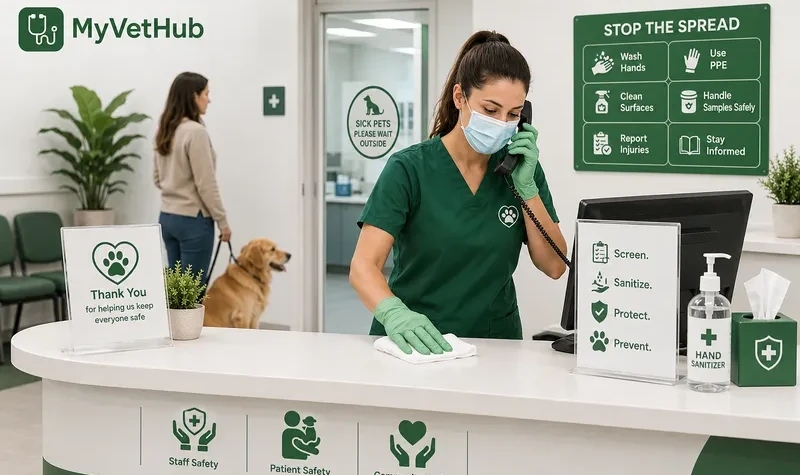
Picture the last dog that walked into your lobby coughing. Someone booked that appointment, greeted the owner, took the leash, maybe accepted a stool sample across the counter, all before a veterinarian had laid eyes on the animal.
That someone was almost certainly at your front desk. And there's a good chance they've never been formally trained on what they were actually handling.
That's the blind spot.
Most practices pour their infection control energy into the treatment area and the isolation room, exactly where it belongs while the reception desk, the first place an unscreened patient lands, runs on instinct and good intentions.
In a year when every practice is watching payroll and margins, closing that gap is one of the cheapest, highest-leverage safety moves you can make. Here's why it matters, and what your front desk actually needs to know.
The Front Desk is the Real Exposure Point
Zoonoses- infections that pass between animals and people. They aren't an exotic risk in veterinary medicine, they're a daily one. The numbers make the point better than any warning could: of the more than 1,400 pathogens known to cause disease in humans, roughly 60% originate in animals, and about three-quarters of newly emerging diseases come from them. Anyone working where people and animals meet is exposed, and the waiting room is one of those places.
The reason the front desk is uniquely vulnerable is timing. Patients arrive before anyone has assessed them, which means a contagious animal can be sitting in your lobby - shedding onto the floor, the counter, the check-in pen, before it's ever been triaged.
That's why professional infection control guidance is unambiguous on one point: an animal that's actively coughing, sneezing, vomiting, feverish, or has diarrhea shouldn't be in the reception area at all. It should be met outside or moved straight to a separate room. But a guideline only works if someone catches the problem in time, and that someone is your receptionist.
Exposure up front tends to happen in ordinary, unglamorous moments, taking a fecal sample at check-in, wiping up an accident in the lobby, absorbing a scratch from a frightened cat. None of these look like clinical procedures. Every one of them is a genuine chance to pick something up or pass it along.
And here's the uncomfortable part: the habits meant to prevent all this are inconsistent even among clinical staff. When researchers have directly observed hand hygiene in companion-animal practices, compliance has landed at just 21-48% and when they asked why people skipped it, the leading answer wasn't arrogance or apathy. It was simply forgetting. That's oddly encouraging, because forgetting is a fixable problem.
Research on infection control also consistently points to support staff, weekend teams, and non-clinical roles as the people most likely to fall outside a practice's written plan, which puts your front desk squarely in the highest-risk, lowest-coverage corner of the building.
The Working Shortlist: Six Habits to Drill Into Your Reception Team
You don't need to turn your receptionist into an infection-control specialist. You need them fluent in a short, practical set of habits, the same fundamentals the profession's standard guidance is built on. Here's the working shortlist.
- Triage before the animal reaches the lobby. Train reception to ask one simple question at booking and again at arrival: is the pet coughing, sneezing, vomiting, showing diarrhea, or carrying a known drug-resistant infection? Any "yes" means the animal waits outside or goes straight to a designated room. It costs nothing, takes ten seconds, and is genuinely the single most valuable thing a front desk can do for infection control.
- Make hand hygiene automatic. It's the most important safeguard there is, and the technique is unfussy: soap and water for 15-20 seconds, or an alcohol-based sanitizer worked over every surface of the hands until dry. The moments that matter are after handling any patient, sample, or soiled item, after cleaning a surface, and before eating. Since forgetting is the real enemy, where you place the dispenser at the desk does more work than any poster on the wall.
- Glove up for the messy stuff. Samples, soiled laundry, contaminated surfaces, gloves on, and hands washed after they come off. Food and drink stay out of any zone where animals or samples are handled. Basic, but routinely skipped when things get busy.
- Handle samples and spills with a system. Fecal samples go into a sealed, labeled container, handled with gloves; anything potentially contaminated gets bagged and labeled before it travels through the building. For a lobby accident, the order is simple and non-negotiable: glove up, clean, then disinfect using the right product at the right dilution and contact time. Rush the contact time and the disinfectant essentially does nothing, which is one of the most common and invisible mistakes a busy front desk makes.
- Treat every bite and scratch as an injury, not an occupational fact of life. Immediate wound care, a medical evaluation because of infection and rabies risk, and a written report every time. A culture where staff shrug these off is a culture one bad day away from a serious problem.
- Know who carries extra risk. Pregnant and immunocompromised team members face greater danger from certain zoonoses, and that awareness belongs in front-desk onboarding, not just the clinical version so those team members can adjust duties or take extra precautions before there's an exposure to react to.
From Binder to Behaviour
Here's where this lands on you specifically. Under federal law, employers carry a legal duty to provide a safe workplace, and the recommended standard is a written, practice-specific safety program covering hazard identification, training, and recordkeeping. You don't have to build it from scratch, the profession's standard reference includes a free, modifiable Model Infection Control Plan you can adapt to your clinic in an afternoon.
Two things separate a plan that protects your team from one that just fills a binder.
The first: it only works if everyone follows it. A protocol honored by 99% of your staff is quietly sabotaged by the 1% who never learned it and if that 1% is the front desk greeting every patient that walks in, the diligence of your entire clinical team is undermined at the door. Keep the relevant portions physically available in reception, and revisit the whole thing at least once a year.
The second: don't reach for gloves first. The most effective control is to keep the hazard out of the building entirely, screening that coughing dog before it enters the lobby beats every downstream precaution combined. Training, check-in scripts, and vaccination policies come next. Personal protective equipment is the backstop, not the front line.
A smart check-in workflow prevents more exposures than a whole case of gloves ever will. And for anyone weighing this against a hundred other priorities, the regulatory math is blunt. Employers are legally required to protect workers from bloodborne and infectious exposures, and a missing exposure control plan is precisely the kind of gap that draws a citation.
Set against numbers like that, a two-hour front-desk training and a laminated check-in script isn't a cost. It's the cheapest insurance you'll ever buy.
The Bottom Line
Your front desk isn't a waiting room with a phone attached. It's the first checkpoint in your entire infection control system and right now, in most clinics, it's the checkpoint nobody trained.
Give that team a handful of well-drilled habits, and you close one of the most overlooked gaps in veterinary workplace safety while protecting your people, your patients, and your clients all at once.
If your infection control plan currently lives in a binder no one at the front desk has ever opened, that's your starting line. It's fast, it's cheap, and this year, those are exactly the wins worth taking.
Sources
All sources below are publicly accessible authoritative or peer-reviewed materials.
- CDC / NIOSH : Hazards to Veterinary Medicine and Animal Care Workers (zoonoses prevalence, sharps, bites, rabies): https://www.cdc.gov/niosh/veterinary/about/hazards.html
- CDC / NIOSH : Veterinary Safety and Health Hazard Prevention and Control (written safety program, worker training, hierarchy of controls): https://www.cdc.gov/niosh/veterinary/prevention/index.html
- AVMA : Compendium of Veterinary Standard Precautions for Zoonotic Disease Prevention in Veterinary Personnel (endorsement page + link to the free, modifiable Model Infection Control Plan): https://www.avma.org/resources-tools/avma-policies/compendium-veterinary-standard-precautions-zoonotic-disease-prevention-veterinary
- Peer-reviewed source of the above: Williams CJ, Scheftel JM, Elchos BL, Hopkins SG, Levine JF. Compendium of Veterinary Standard Precautions for Zoonotic Disease Prevention in Veterinary Personnel. J Am Vet Med Assoc. 2015;247(11):1252–1277. https://pubmed.ncbi.nlm.nih.gov/26594810/
- AAHA : 2018 AAHA Infection Control, Prevention, and Biosecurity Guidelines (reception-area exclusion of symptomatic animals, isolation protocols): https://www.aaha.org/wp-content/uploads/globalassets/02-guidelines/infection-control/icpb_guidelines.pdf
- BMC Veterinary Research / PMC : Video observation of hand hygiene practices in companion animal clinics (observed compliance 21–48%): https://www.ncbi.nlm.nih.gov/pmc/articles/PMC4108058/
- The Canadian Veterinary Journal / PMC : Self-reported hand hygiene perceptions and barriers among companion animal veterinary clinic personnel in Ontario ("forgetting" as the top barrier): https://ncbi.nlm.nih.gov/pmc/articles/PMC4751768
- U.S. Department of Labor : OSHA Penalties (current maximum civil penalty amounts): https://www.osha.gov/penalties