
When Disaster Strikes Your Clinic: A Practical Staff Training Guide for Veterinary Teams
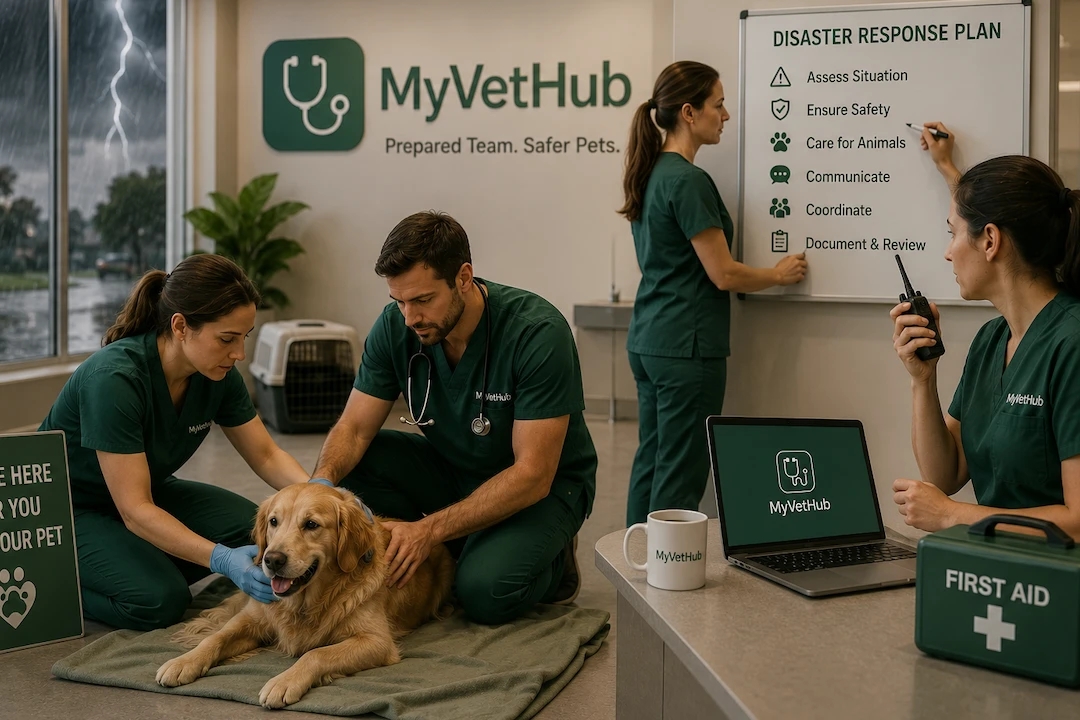
Most veterinary clinics have an emergency plan. It lives in a binder, a shared drive folder, or a laminated sheet near the back door, written, filed, and, if we're being honest, never really opened again.
That binder is not a training program. When something goes truly wrong, a document nobody has read since it was printed offers your team almost nothing. Emergencies don't schedule themselves around your quietest Tuesday; they happen mid-surgery, or on a Saturday with two staff members and a waiting room full of dogs. The team's response in those first few minutes is shaped by what they've practiced, not what's written down somewhere.
The National Oceanic and Atmospheric Administration confirmed 28 billion USD weather and climate disasters across the United States in 2023, a record, followed by 27 more in 2024: wildfires, floods, and storms that sent frightened pet owners through veterinary doors with no plan for what came next.
The American Veterinary Medical Association has said plainly what every veterinarian already knows: animals face the same disasters people do, and veterinary teams are vital to the response. The question isn't whether your clinic will face an emergency. It's whether your team will know what to do when it does.
Natural Disasters: When Your Clinic Becomes the Front Line
A fire alarm gives you a chance to walk out. An earthquake doesn't. One minute someone is doing a routine dental cleaning; the next, the building is shaking and every animal in your kennels is terrified at once. There is no time to figure out who is supposed to do what. That decision needs to have been made weeks ago, practiced, and remembered.
This is the core of real emergency training: it's role-based and specific. Not "everyone evacuates," but you check every animal in the dog ward, you know exactly where the gas shut-off valve is because you've physically operated it during a drill, and you go straight to the cat recovery room because you've already practiced safe feline restraint. Every person. Every area. Decided in advance.
Teach protocols at onboarding, reinforce them once or twice a year, and vary the drills: an earthquake scenario, a flood shelter-in-place, a smoke event. Someone per shift should own every kennel and recovery room, since people drift toward exits during a structural emergency and animals get left behind. Restraining a panicked dog is nothing like restraining a panicked cat, and both species need a place in your drills.
Smoke Inhalation in Dogs and Cats: The Silent Damage You Cannot See
Wildfire smoke has moved from a regional concern to a year-round reality for veterinary practices, and it's clinically more complicated than most realize, because the damage often doesn't show up right away. Dogs and cats may face greater risk than their owners from smoke: they breathe faster, can't wear masks, and being lower to the ground means they inhale concentrated particulates that have already dispersed by the time they reach human breathing height.
The worst damage frequently surfaces after the animal leaves the smoky environment, not during it. PetMD's January 2025 guidance documents that airway ulcers can develop within 48 to 72 hours of exposure, often before any outward symptoms appear, and VCA Animal Hospitals confirms most cases need at least three days of monitoring as a result.
A dog or cat who seems "okay" at intake after a fire event may not be okay 48 hours later. Dogs tend to show coughing, excessive panting, and flat energy, with brachycephalic breeds like pugs and bulldogs at highest risk.
Cats often present with coughing, gagging, and withdrawal, with Persian and Exotic Shorthair cats facing similarly elevated risk. Severe cases may need oxygen therapy and IV fluids. Make checking AirNow.gov at the start of every shift during fire season a habit.
Why Your Reception Staff Need Emergency Training Too
Here's what rarely gets said in emergency training guides, but comes up in every real event: when a disaster hits, the hardest part of your clinic's day isn't always the animal. Sometimes it's the person carrying them in.
Think about what that owner has been through. They evacuated at 2 a.m. with their cat in a carrier and a bag they grabbed in ten minutes. They don't know if their house is still standing. They've been in their car for hours. Their dog is injured or terrified, and they're walking into a clinic they may never have been to before, handing their animal to strangers. They are not calm. They are not processing information well. And they absolutely will not respond the way they would during a normal appointment.
Clients in acute stress can experience tunnel vision, difficulty taking in information, and emotional reactions that seem outsized but are entirely predictable. What actually helps, more than explanations, more than clinical updates, is being genuinely acknowledged. Empathizing with what a pet owner is feeling, and naming it out loud, de-escalates the situation faster than anything else you can do.
Industry insights highlight something clinics often miss: the person at the front desk, your CSR, is usually the first one to receive that panicked call or walk-in. Training front-line staff to handle these critical moments isn't just compassionate practice. It directly reduces staff burnout and the kind of emotional exhaustion that drives turnover in veterinary medicine.
Leading veterinary communication and emergency care frameworks recommend separating clinical responsibilities from client communication during high-pressure situations. While medical teams work to stabilize and treat the patient, a designated staff member should keep the owner informed, explain next steps, and provide realistic timelines. Establishing these processes before an emergency occurs allows clinics to respond more effectively and compassionately. Clear communication reassures pet owners and helps them feel supported throughout a stressful experience.
How Man-Made Incidents Put Dogs and Cats at Risk
When a chemical spill or industrial accident happens near a residential area, dogs and cats are typically the most exposed animals around. They're close to the ground where vapor and residue concentrate, they groom themselves constantly, turning skin contact into ingestion, and they investigate everything with their noses and mouths.
The 2023 NASAAEP Best Practices in Disaster Veterinary Medical Response, developed with the AVMA and USDA, identifies a persistent gap: companion animal decontamination protocols are consistently absent from local hazmat response plans, and a 2024 Texas A&M study published in Disaster Medicine and Public Health Preparedness confirmed clinics frequently receive chemically exposed animals with no decontamination process in place.
Every clinic needs a decontamination step at the door, rinsing any animal with possible exposure before it crosses the threshold, a scripted front-desk response for CSRs handling incoming calls, and the ASPCA Animal Poison Control Center's toxin exposure triage sheet posted at every workstation, alongside their hotline, 888-426-4435.
Building a Training Program That Doesn't Just Sit in a Folder
The drills, protocols, and communication training only work if they're built into how your clinic actually operates, not treated as a once a year exercise. Start with the AVMA, which offers a free guide for writing an emergency plan and a Veterinary First Responder Certificate Program covering eight core competencies. Make RECOVER certification standard for every clinical staff member: in June 2024, the RECOVER Initiative released updated CPR guidelines for dogs and cats following a review of more than 1,370 studies by 102 specialists, the only evidence-based standardized CPR guidelines in veterinary medicine.
Run drills covering multiple scenarios, not just fire exits, and involve local fire and EMS in developing your plans. After hard events, build in time for genuine debriefs; staff who feel supported stay, and the institutional knowledge that walks out the door with those who don't cannot be rebuilt quickly.
The Bottom Line
Your dogs and cats cannot tell you they're scared. They can't explain what they were exposed to or ask for what they need. In an emergency, your team speaks for them, and the quality of that voice depends entirely on decisions made long before anyone needed them.
Emergency preparedness isn't something you finish once. It needs to be reviewed, updated, and practiced, because the animals coming through your door deserve a team that's ready for them.
Sources
NOAA NCEI: 28 disasters (2023) / 27 disasters (2024) : noaa.gov/climate
AVMA: Disaster preparedness statement + resources : avma.org/disaster-preparedness-policies-and-resources
AVMA: Emergency planning guide for veterinary practices : avma.org/emergency-planning-veterinary-practices
AVMA: Veterinary First Responder Certificate Program : avma.org
Cornell University CVM: Dog safety during poor air quality : vet.cornell.edu (updated Dec 2025)
PetMD: Smoke inhalation in dogs and cats 48-72 hr window : petmd.com (Jan 14, 2025)
NASAAEP: 2023 Disaster Veterinary Medical Response Best Practices : thenasaaep.com/best-practices
ASPCA Pro: APCC Toxin Triage Sheet + hotline 888-426-4435 : aspcapro.org
RECOVER Initiative: 2024 Updated CPR Guidelines for Dogs and Cats : recoverinitiative.org/2024-guidelines