
AI in Veterinary Practices: Where It's Working, What It's Fixing, and What It's Worth
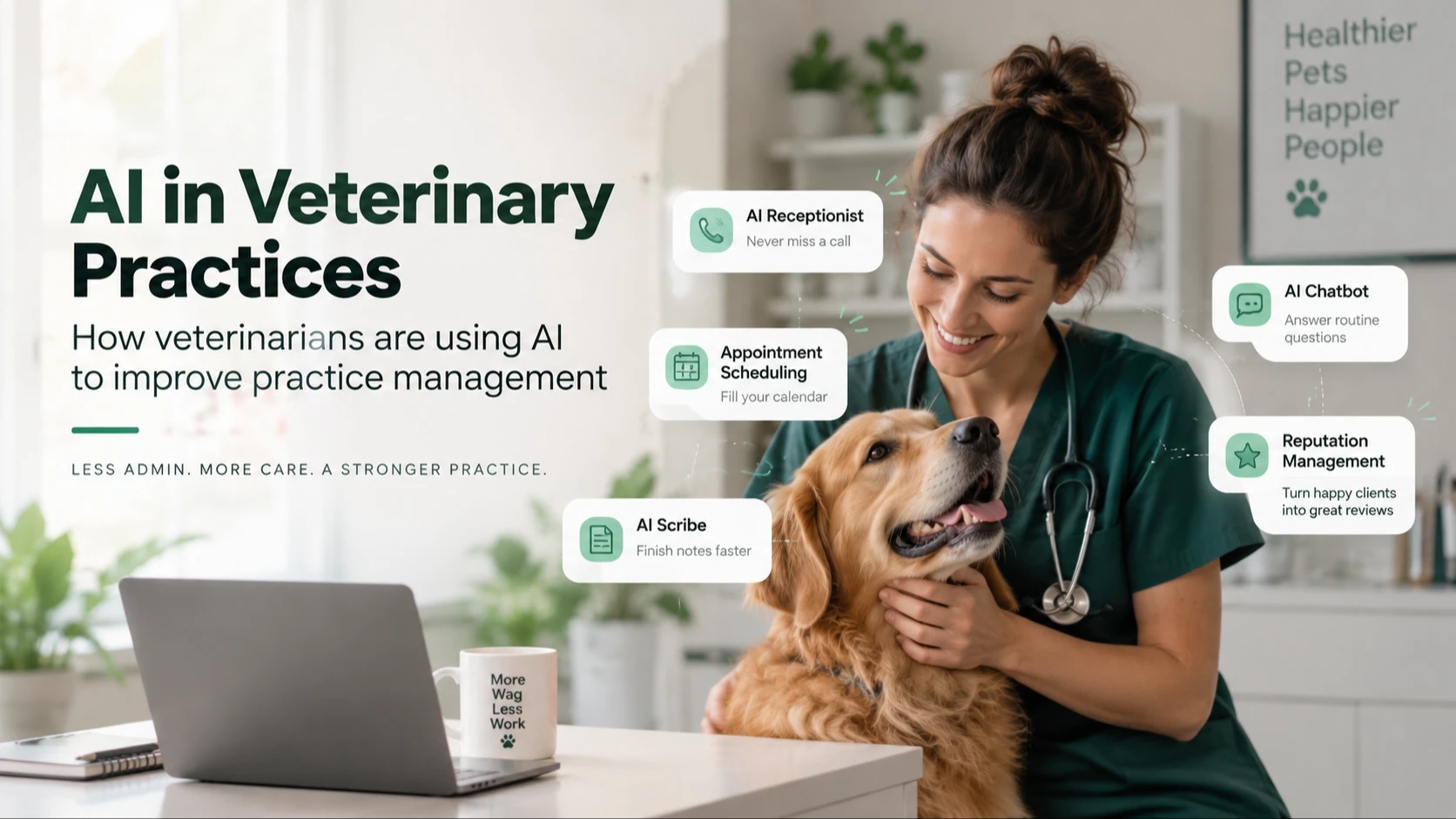
A look at where artificial intelligence is currently used in U.S. veterinary practices, based on available industry data, including its role in client communication, online reviews, and administrative work.
At a Glance
- 39.2% of veterinary professionals already use AI tools in their practice.
- Almost all of that use falls into three jobs: imaging, admin work, and voice-to-text scribing.
- The two real barriers holding the rest back are reliability concerns and data security, not lack of interest.
- Most negative reviews on a vet clinic are about communication, not the quality of care.
- Several of the "statistics" repeated across vet marketing blogs about missed calls and lost revenue trace back to reports that don't actually exist.
In this article: what the AI adoption number actually means, where AI is already working inside real practices, why it can fix more bad reviews than most clinics expect, what to do about the phone and after hours calls, how to check whether your practice really has a slow period, and a simple way to think about buying vet tech without overpaying for tools you don't need yet.
Search for AI in veterinary medicine and you'll find two very different conversations happening at once. One is full of hype, AI as some distant, half built promise. The other is a lot quieter, and a lot more real: a growing share of practices already using it, every day, for a small number of specific jobs. This piece is about the second conversation.
39% of Veterinary Professionals Report Using AI Tools in Their Practice
39.2% of veterinary professionals report using AI tools in their practice, according to a survey run by Digital and AAHA. That's not a projection or a marketing claim. It's a direct, disclosed survey finding. PR Newswire / dvm360
It's tempting to explain this with a veterinarian shortage story, but that's not quite accurate. The National Academies ran a full workforce study in 2024 and found no overall shortage of veterinarians, just some unfilled positions in specific sectors. What is real is pressure on the time DVMs already have. Visit volume has been falling for four years running while clients grow more cost sensitive, which means the hours a veterinarian actually spends treating animals matter more than ever. That's the real story behind AI adoption. It isn't filling an empty seat. It's protecting the hours a DVM already has for the parts of the job only a DVM can do.
AI Adoption in Veterinary Practices Is Concentrated in a Few Specific Tasks
When you look at where AI is actually being used inside practices right now, it comes down to three things: imaging and radiology, administrative tasks, and voice to text transcription. dvm360 Imaging is its own specialized category, reading X-rays and scans, and outside the scope of this piece. The two that affect a practice's daily operations, and where the rest of this section is focused, are administrative work and documentation.
The administrative bucket is worth sitting with for a second, because it's bigger than it sounds. It's prescription refill requests. Food order questions. "Is my appointment still at 2?" It's the steady stream of small, repetitive, non clinical requests that end up landing on a DVM or an already stretched front desk anyway, because there's no other system built to catch them. That's the exact gap Vera AI is built to close, answering the routine prescription and food order questions that don't need a veterinarian's attention, so that attention goes back to actual treatment.
Voice to text scribing is its own story, and a fast moving one. Search interest in "veterinary AI scribe" is up 160% year over year, with current adoption estimated at somewhere between 10 and 25% of practices. Exponential Vet Trends The methodology behind that specific report is only loosely disclosed, so treat the exact percentages as directional rather than precise, but the direction itself is clear and consistent with everything else in this data. An AI scribe does the same job as Vera AI from a different angle: instead of freeing a DVM's time by answering client questions, it frees that time by handling the documentation that follows every appointment.
None of this works as a fair picture without naming the real hesitation too. 70.3% of vets cite reliability and accuracy concerns about AI, and 53.9% cite data security and privacy. AVMA Those are reasonable concerns, and they point to something useful: task specific AI, the kind that answers a food order question or transcribes a visit, carries a lot less risk than AI making an actual clinical judgment call. That distinction is probably the single most useful filter for a practice deciding where to start.
Negative Reviews on Veterinary Practices Are Usually About Communication, Not the Quality of Care
Here's a finding that should change how a lot of practices think about their online reviews. AVMA's own guidance on reputation management states plainly that negative reviews of veterinary practices mostly cite problems with customer service and communication, not the quality of care provided. AVMA
That matters because reviews carry real weight before a client ever sits down in an exam room. 85% of people say positive reviews make them more likely to use a business, and 74% check two or more review sites before deciding. Only 4% say they never read reviews at all. BrightLocal / BrightLocal 2025
Put those two findings together and the fix stops looking like a medical problem and starts looking like a communication problem. A clinic that answers questions quickly, follows up consistently, and doesn't leave a client waiting on hold is protecting its reviews just as much as it's protecting its efficiency. This is where the case for AI shifts from convenience to something closer to reputation insurance. Vera AI answering a routine question at 6pm instead of a client sitting on hold, or an AI scribe keeping a vet present and unhurried during an appointment instead of visibly rushing to finish notes, both change the experience a client walks away with and, eventually, what they write about it.
One more number worth knowing here: 83% of people who are asked to leave a review actually leave one. BrightLocal Good reviews mostly don't happen on their own. They happen because someone asked, and that's a system a practice can build just as deliberately as anything else on this list.
The Phone Remains a Veterinary Practice's First Point of Contact With New Clients
Before a client reads a review or books an appointment, there's usually a phone call. And it's often the piece of a practice's setup that's changed the least in years.
There isn't reliable, vet specific data on what percentage of calls a practice misses, despite how often that number gets thrown around. Every version of it traced back to fabricated citations of reports that don't actually exist. What is real, though not vet specific, comes from CallRail's 2025 consumer survey: 78% of consumers say they've abandoned a business entirely after a call went unanswered, and 82% say they'd call a competitor instead. CallRail, via OnCrew That's general small business behavior, not a veterinary number, but it's a fair stand in for why the phone still matters this much.
Instead of guessing at a lost revenue figure, it's more honest to think about the stakes in terms of what's already been verified: the average veterinary client is worth roughly $5,000 over the course of the relationship. GeniusVets A missed call from a new client isn't just a missed call. It's a missed shot at that relationship.
This is where a modern phone system paired with Vera AI earns its place: routing and answering the repetitive questions automatically, while making sure anything that actually needs a person still rings through to one.
After-Hours Calls Include Both Routine Questions and Genuine Emergencies
Not every after hours call is the same, and treating them all the same way is where most practices lose ground.
One kind is a routine question from an existing client who happens to be calling at 9pm. The other is a genuine emergency, where the only acceptable outcome is getting that person routed to the nearest emergency clinic, fast and accurately. One veterinary triage service, VetTriage, reports that more than 80% of the after hours cases it handles turn out not to need an ER visit at all. That's VetTriage's own reported number, not independently verified research, but it's a useful signal for how often "emergency" and "genuine emergency" turn out to be different things. VetTriage
A practice doesn't need to staff the phones overnight to handle this well. It needs a system that can tell the two situations apart and act on that difference immediately, routing a real emergency to the nearest emergency clinic while queuing a routine question for the morning. That's the practical role Vera AI and a clinic's phone system play together after hours, not replacing judgment, just making sure the right call gets the right response at 2am instead of at 9am.
Identifying a Practice's Slow Periods Requires Looking at Its Own Scheduling Data
You'll hear practice owners talk about having one slow day a week, and it's tempting to name a specific one. There's no real data anywhere, vet specific or otherwise, that supports a single universal slow day across the industry. If a claim like that shows up in an article with no source attached, that's worth being skeptical of.
What is worth doing is finding out whether your own practice actually has one. An appointment system connected to your real calendar can show you your own slow hours from your own booking history, not someone else's guess. Once you know where they actually are, you can do something useful with that window: a targeted discount code or a promoted slot for that specific stretch of time, instead of discounting across the board and giving up margin on hours that were already busy. That's exactly the kind of pattern MyVetHub's Appointment Manager is built to surface directly from a clinic's own calendar.
Choosing Veterinary Practice Software Starts With Identifying the Problem It Needs to Solve
Most guides to picking veterinary practice software walk through a feature checklist. A more useful filter is asking what specific, measurable problem you're actually trying to solve.
Start with where the real gaps are. Practice management software itself is nearly universal already, 76.5% of practices have one in place, so that's rarely the decision left to make. The real gaps are online booking, at only 33.4% adoption, and telehealth, at 29.2%. AVMA Economic State of the Profession 2025 If your practice is missing one of those, that's a more useful starting point than a general search for "best vet software."
From there, a short, honest checklist helps: does it integrate with the practice management system you already run, does it solve one problem you can name rather than promising to solve everything, can you actually test it against your own numbers before committing, and does the company selling it show its work when it cites a statistic. That last one matters more than it sounds like it should, given how much of the data floating around this industry turns out to be made up.
Bundled, All-in-One Platforms Often Cost More Than the Tools a Practice Actually Needs
A platform that sells you every tool in one bundle isn't solving your problem for you. It's spreading the same budget thinner across tools you may not need yet.
The goal of any technology spend is getting the most back for the least wasted investment. A practice with a phone problem should be able to buy a phone solution. A practice with a booking problem should be able to buy a booking solution. Neither should have to also pay for AI, website, or SEO tools they're not ready to use yet just because a vendor only sells in one size.
That's the whole argument for going modular instead of all in one, and it's also, plainly, the reason MyVetHub is built the way it is.
Frequently Asked Questions
Is AI actually reliable enough to use in a veterinary practice yet? It depends heavily on the task. Task specific AI, answering a routine question or transcribing a visit, carries far less risk than AI making a clinical judgment call, which is exactly why adoption is concentrated in admin work and scribing rather than diagnosis. The two real concerns vets report, reliability and data security, are reasonable, and they're a good filter for deciding where to start rather than a reason to avoid AI altogether.
What's the difference between an AI scribe and a tool like Vera AI? An AI scribe handles documentation during and after an appointment, freeing a vet from writing notes by hand. A tool like Vera AI handles the client facing side instead, answering routine questions like prescription refills or food orders so they don't land on a DVM or an already busy front desk. They solve the same underlying problem, protecting a vet's time, from two different directions.
Do bad reviews really have nothing to do with the quality of care a clinic provides? Not nothing, but less than most clinics assume. AVMA's own guidance states that negative reviews mostly cite communication and customer service problems rather than the medicine itself. That's actually useful news, because a communication problem is far more fixable than a clinical one.
How does after hours call routing actually work for a small practice? The goal is telling a routine question apart from a real emergency and acting on that difference immediately, rather than treating every after hours call the same way. A genuine emergency gets routed straight to the nearest emergency clinic. A routine question from an existing client can be handled or queued until morning. Neither requires staffing the phones overnight.
How do I know if my own practice has a real slow period, and what should I do about it? Check your own booking data rather than assuming a specific day. If a real pattern shows up, a targeted discount or promoted slot for that specific window makes more sense than discounting across the board, since it fills genuinely empty capacity instead of giving up margin on hours that were already busy.
Should I buy an all in one vet tech platform or piece together individual tools? Start with the one problem you can actually name, a phone problem, a booking gap, a review problem, and solve that first. A platform that only sells everything bundled together usually means paying for tools you're not ready to use yet, which works against the return you're trying to get from the investment in the first place.
MyVetHub builds VOIP, Website and SEO, Vera AI, and an Appointment Manager as separate, modular tools for U.S. veterinary clinics, so a practice can solve one real problem at a time, a slow phone, a review problem, a scheduling gap, without paying for a platform it doesn't need yet. Talk to our team this week about which piece fits your practice first, and see exactly how it works before deciding on anything else.