
AI Receptionist for Veterinary Clinics vs Human Staff: The Real Cost Comparison
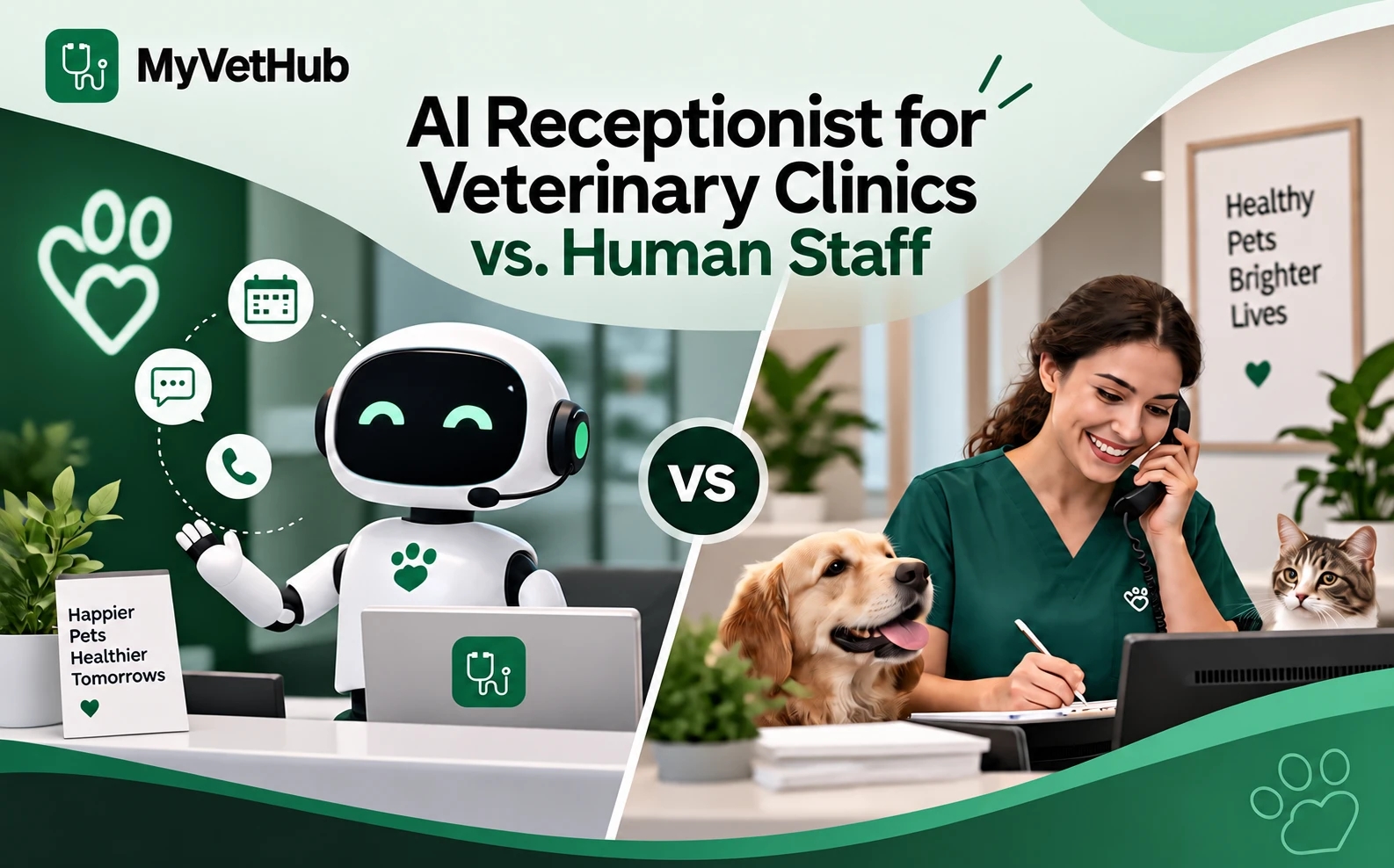
Your front desk can be doing everything right and still miss a potential new client.
The phone rings while your receptionist is checking in a patient, helping an anxious pet owner, processing a payment, or already speaking with someone else. By the time they are free, the caller may have hung up and contacted another clinic.
That leaves veterinary hospital owners, DVMs, and practice managers with an increasingly relevant question:
Do you need to hire another receptionist, or can an AI receptionist handle enough of the phone workload to avoid adding more staff?
The answer is more complicated than simply saying, “AI is cheaper.”
A veterinary receptionist does much more than answer the phone. At the same time, modern AI receptionists can now handle tasks that traditional answering services and phone trees could not. Depending on the system, they may be able to check schedules, identify existing clients, collect patient information, answer routine questions, and even book appointments directly into veterinary practice-management software.
So the most useful comparison is not really AI versus humans as employees.
It is AI versus humans for specific front-desk tasks.
This guide compares the two across cost, availability, appointment scheduling, missed calls, client experience, emergency escalation, scalability, integration, and return on investment.
What is an AI Receptionist for Veterinary Clinics?
A veterinary AI receptionist is a voice-based software system that can speak with pet owners over the phone and complete approved front-desk workflows.
It is not the same as an old-fashioned “Press 1 for appointments” phone tree.
Modern systems use conversational AI to understand why someone is calling, respond in a more natural way, collect information, access connected systems, complete authorized actions, and escalate calls when predefined conditions are met.
Exactly what the system can do depends heavily on the platform, configuration, and level of integration.
What Can a Veterinary AI Receptionist Actually Do?
Depending on the product and setup, current systems may be able to:
- Answer incoming calls
- Provide after-hours or 24/7 phone coverage
- Respond to approved questions about the clinic
- Check appointment availability
- Book eligible appointment types
- Reschedule appointments
- Identify existing clients and patients
- Collect new-client and new-patient information
- Capture prescription refill requests
- Take structured messages
- Transfer calls
- Follow clinic-defined escalation rules
- Record or summarize interactions
- Handle multiple conversations at the same time
- Send information into connected practice systems
The key phrase is depending on the system. Not every AI receptionist offers every capability, and integration depth varies significantly between vendors.
The Real Veterinary Receptionist Cost
Before comparing AI with human staffing, it helps to establish a realistic cost baseline.
According to the U.S. Bureau of Labor Statistics' current Occupational Outlook Handbook, the median receptionist wage was $18.27 per hour in May 2025, or approximately $38,010 per year for a full-time employee.
Receptionists working in healthcare and social assistance had a median wage of $19.00 per hour.
National Occupational Employment and Wage Statistics also report a mean receptionist wage of $18.97 per hour, or $39,460 annually.
These figures are May 2025 wage measurements published in the current 2026 BLS release. They are not wages measured during 2026.
References:
https://www.bls.gov/ooh/office-and-administrative-support/receptionists.htm
https://www.bls.gov/news.release/ocwage.t01.htm
BLS also projects receptionist employment to decline 2% from 2025 to 2035, while still estimating approximately 105,100 openings per year on average. Most of those openings are expected to result from workers leaving the occupation or exiting the workforce.
Reference:
https://www.bls.gov/ooh/office-and-administrative-support/receptionists.htm
Why Salary Alone Understates Front-Desk Cost
If you pay a receptionist $18.27 per hour, the practice's actual cost is not simply $18.27 for every productive hour of front-desk work.
Depending on the clinic, additional costs may include:
- Employer payroll taxes
- Health insurance or other benefits
- Paid time off
- Recruiting
- Onboarding
- Training
- Overtime
- Turnover
- Management time
- Equipment and workspace
- Coverage during absences
A more useful way to think about it is:
Fully loaded receptionist cost = wages + employer payroll costs + benefits + recruiting + training + paid nonproductive time + coverage costs + applicable overhead
Every practice should use its own payroll and accounting data rather than relying on national averages alone.
Illustrative Cost of One Full-Time Receptionist
Using the national median wage:
$18.27 × 40 hours × 52 weeks = approximately $38,002 in annual base wages.
That is nearly identical to the BLS annual median of $38,010.
But this is still base compensation, not a universal all-in employment cost.
For example, suppose payroll taxes, benefits, PTO, recruiting, training, equipment, and other attributable costs increase the clinic's effective cost by an illustrative 25%.
The calculation would be:
$38,010 × 1.25 = $47,512.50 per year
Or approximately:
$3,959 per month
The 25% figure is only an example. It is not a veterinary-industry statistic, and practices should replace it with their own numbers.
That distinction matters when comparing human labor with AI.
How Much Does an AI Receptionist Cost for a Veterinary Clinic?
There is no authoritative national average price for a veterinary AI receptionist.
Pricing varies based on factors such as:
- Call volume
- Usage
- Number of locations
- Practice-management integrations
- Supported workflows
- Languages
- Implementation requirements
- Whether the system only answers calls or can complete actions
Public vendor pricing can provide a useful reference point, but it should be viewed as vendor-specific pricing rather than an independent industry average.
AI Receptionist vs Human Receptionist
An AI receptionist for veterinary clinics is generally best suited to repetitive, high-volume phone tasks. That can include answering routine questions, collecting client information, covering after-hours calls, managing overflow, and, when properly integrated, booking approved appointment types.
Human receptionists remain much better suited to work that requires empathy, judgment, flexibility, conflict resolution, physical presence, or handling unusual situations.
Here is a practical comparison:
Capability | Veterinary AI Receptionist | Human Receptionist |
24/7 phone availability | Strong | Requires multiple shifts or coverage |
Multiple simultaneous calls | Strong where concurrency is supported | Limited per employee |
Routine FAQs | Strong | Strong |
Basic appointment scheduling | Strong with proper integration | Strong |
Complex scheduling exceptions | Limited by configured rules | Strong |
In-person check-in | No | Strong |
Emotional conversations | Limited | Strong |
Grieving clients | Should escalate | Strong |
Clinical judgment | No | Not a substitute for clinical staff |
Emergency recognition | Rule-based triage and escalation | Contextual escalation |
Repetitive data capture | Strong | Strong |
Physical office tasks | No | Strong |
Scaling phone capacity | Usually fast | Requires additional staffing |
PTO and sick-day coverage | Not applicable | Required |
Relationship building | Limited | Strong |
Consistency on defined workflows | Strong | Depends on training and workload |
Using the BLS median as a starting point, here is a simplified comparison:
Cost Factor | Human Receptionist | AI Receptionist |
Published starting point | $38,010/year median base wage | Vendor dependent |
Illustrative example | ~$47,513/year with 25% assumed load | $11,964/year at $997/month |
24/7 coverage | Not from one employee | Potentially |
Simultaneous calls | Limited | Potentially multiple |
PTO | Yes | No |
Recruitment | Yes | No employee recruitment |
In-person work | Yes | No |
Complex human interaction | Strong | Limited |
Scaling | Additional labor may be required | Often software capacity/configuration |
Clinical judgment | No | No |
Important: The $47,513 figure is an illustrative calculation. The $11,964 figure is based on one vendor's publicly advertised starting price. Neither represents a universal industry cost.
Using those numbers only as an example:
$47,512.50 − $11,964 = $35,548.50
It would still be misleading to conclude that “AI saves $35,548.50 per receptionist.”
Why?
Because an AI receptionist cannot check a pet into the hospital, help an elderly client at the counter, manage a crowded lobby, comfort someone facing euthanasia, handle physical paperwork, or perform many of the other responsibilities that veterinary CSRs take on every day.
Cost comparisons only become meaningful when you compare the cost of performing the same work.
Is an AI Receptionist Cheaper Than Hiring a Receptionist for a Vet Clinic?
For repetitive phone-based workflows, an AI receptionist can be significantly less expensive than adding equivalent human phone coverage.
That does not make it an apples-to-apples replacement for an employee who also handles in-person service, emotional conversations, exceptions, and other front-desk responsibilities.
The economic case for AI is strongest when the practice has a phone-capacity problem rather than a general staffing problem.
AI May Make Sense When Your Main Problems Are:
- Missed calls
- Calls during lunch
- After-hours inquiries
- Routine appointment requests
- Frequent rescheduling
- Repetitive questions
- New-client intake
- Peak-period overflow
- Multiple callers arriving at once
If your receptionist is constantly pulled away from people standing at the front desk because the phone will not stop ringing, automation may create more value as capacity relief than as a replacement for staff.
Estimating the Opportunity Cost of Missed Calls
A simple starting formula is:
Missed calls × percentage with appointment intent × booking conversion rate × average initial transaction value
For example, suppose a clinic has:
- 300 missed calls per month
- 40% that are genuinely appointment-related
- A 50% expected booking conversion rate
- A $125 average initial appointment transaction
The illustrative opportunity value would be:
300 × 40% × 50% × $125 = $7,500 per month
That does not mean the practice definitely lost $7,500.
Some callers will try again. Some will leave a voicemail. Some will not be a fit for the practice. Others may already be clients, and some appointment requests would not have converted.
The calculation is useful for a different reason: it shows the size of the opportunity worth investigating.
For a meaningful estimate, replace every assumption with your own call and practice data.
Can an AI Receptionist Book Appointments for a Veterinary Clinic?
Yes. Some veterinary AI receptionist systems can check live availability and book appointments directly into supported practice-management systems.
Others do something much simpler: they collect an appointment request and pass it to a staff member for follow-up.
Those are not the same capability, so practices should understand exactly what they are buying.
Direct Booking vs Appointment Requests
- Direct booking: The AI checks eligible availability and places an approved appointment directly onto the schedule.
- Appointment request: The AI gathers the caller's information and sends the request to a staff member, who later decides where and when the patient should be scheduled. Direct booking can remove more administrative work, but it also requires tighter configuration, reliable integration, and clear scheduling rules. A well-designed system should follow the clinic's policies. It should not improvise when it encounters an exception.
What Happens When a Pet Owner Calls With an Emergency?
This is one of the most important questions to ask any AI receptionist vendor.
There is a major difference between:
recognizing signs of urgency and following a predefined escalation protocol
and
making a clinical diagnosis
An AI receptionist should operate within clearly defined clinic rules.
Depending on the practice and technology, an appropriate workflow might involve collecting essential information, recognizing predefined emergency language, immediately transferring the caller, providing approved emergency-hospital instructions, or alerting designated staff.
What it should not do is act as a substitute for veterinary clinical judgment.
AI phone automation should never independently diagnose an animal, prescribe treatment, or make clinical decisions.
Where a Veterinary AI Receptionist Has the Advantage
AI tends to be most useful in areas where the limits of human phone coverage become obvious.
- Availability: Software can potentially answer calls outside normal business hours without requiring a night shift.
- Concurrency: A human receptionist can generally manage one meaningful phone conversation at a time. An AI system may be able to handle several conversations simultaneously, depending on the provider and service plan.
- Consistency: Once a workflow is properly configured, the system can apply the same rules repeatedly without becoming distracted or overloaded.
- Routine Data Capture: Names, pet information, callback numbers, appointment reasons, and other structured information are well suited to automation.
- Scalability: A sudden spike in calls does not necessarily require recruiting and onboarding another employee.
- Structured Analytics: Digital phone interactions can also create useful operational data, depending on the platform. That may include information about call reasons, peak periods, bookings, transfers, and unresolved requests.
The Better Question: AI vs Human, or AI + Human?
For many veterinary hospitals, the most practical answer may be a hybrid model.
Instead of asking AI to replace the receptionist, use it to protect the receptionist's time and attention.
A workflow might look like this:
- AI receptionist: answers routine incoming calls → identifies intent → handles approved FAQs → gathers information → schedules eligible appointments → escalates exceptions
- Human CSR: handles complex escalations → manages emotional conversations → deals with unusual situations → serves clients physically present in the clinic → coordinates front-desk activity
- DVM or clinical team: steps in when clinical expertise or veterinary judgment is actually required
This changes the question from:
“How many people can AI replace?”
to:
“How much repetitive interruption can we remove from skilled staff?”
In a veterinary environment, that is usually the more useful productivity question.
Final Takeaway
Before hiring another receptionist or assuming AI can replace one, measure at least 30 days of inbound calls, missed calls, call reasons, after-hours demand, booking conversion, hold time, and front-desk interruptions.
Then compare human staffing, AI, and hybrid coverage against the same workload and outcomes.
The best veterinary front desk is not necessarily the one with the most employees or the most automation.
It is the one that helps pet owners reach the right person quickly while protecting veterinary professionals' time for work that genuinely requires human skill and judgment.
If unanswered calls are already a measurable bottleneck, start by quantifying them.
That one number may help you decide whether your next investment should be another employee, better workflows, an AI receptionist, or some combination of all three.
Your veterinary team's time belongs with patients, not ringing phones. See how MyVetHub can help turn missed calls into handled conversations, booked appointments, and a front desk that feels more manageable. Book A Demo and see how VERA AI receptionist works.