
We Audited 102 Real Veterinary Websites. Here's What Every Checklist Article Gets Wrong.
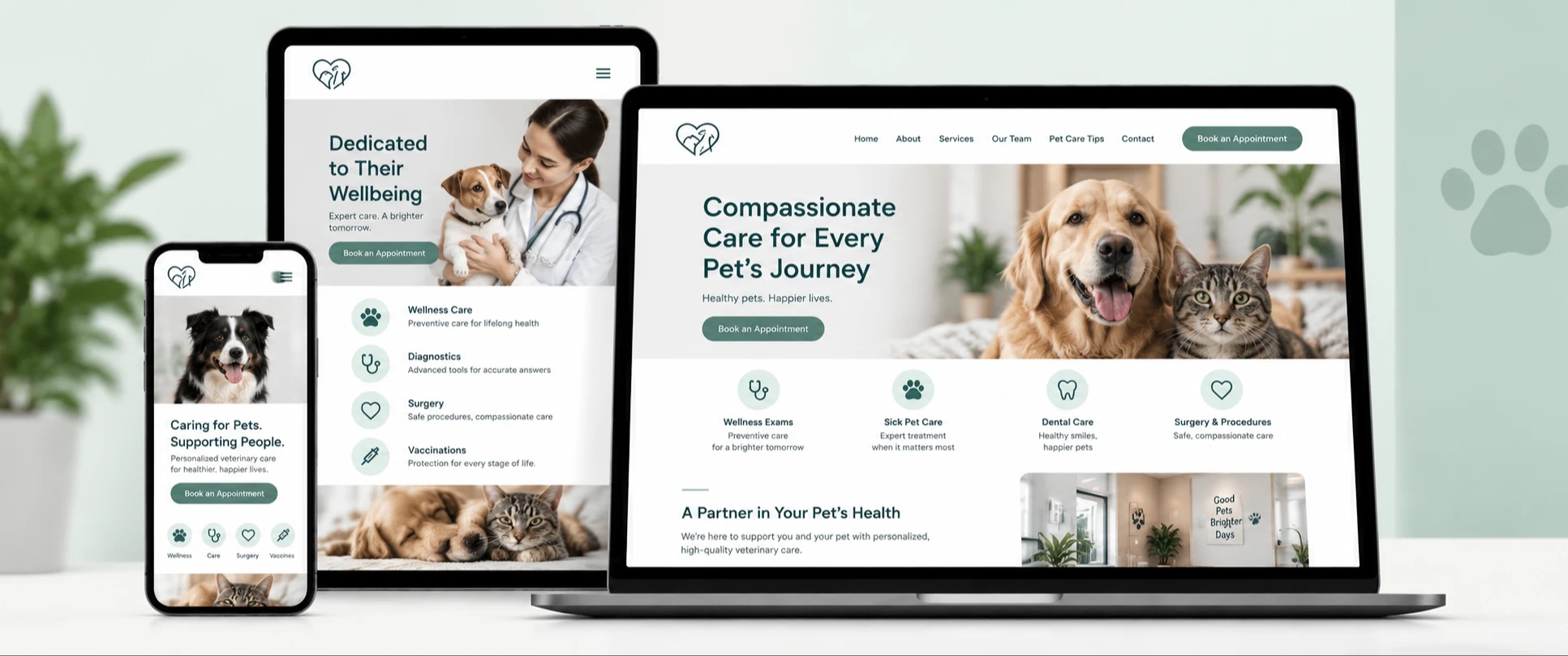
Every guide to building a vet website repeats the same eight tips. We checked 102 real clinic sites against them, and found that a good website is now the price of admission, not the competitive edge.
At a Glance
- We audited 102 real, independent U.S. veterinary clinic websites across more than 20 states.
- 89.2% now have mobile-responsive design, and 94.1% clearly list their services. Both are already basically solved industry-wide.
- 62.7% offer online booking. That means over a third of clinics still require a phone call to book a visit.
- Only 11.8% have staff bios a visitor can actually read without hitting a dead link or a "coming soon" page.
- 17.6% show a clear sign of neglect, from a stale copyright year to a live website for a practice that's already closed.
- The basics are now solved for most clinics, which means SEO and reputation, not the website alone, are where a real edge still exists.
In this article: the pattern every website guide repeats, why a website decides trust before the phone ever rings, why mobile speed matters, the full audit results, why a good website no longer sets a clinic apart on its own, a five-minute self-check for your own site, what a weak site actually costs, what to look for in a website partner, and answers to the most common questions.
Search for advice on building a veterinary website and you'll find dozens of guides, written by different people in different words, that all land on roughly the same eight ideas: make it mobile-friendly, keep it fast, list your services clearly, add online booking, show reviews, keep a blog. Every one of them tells a clinic what it should do. None of them check whether real clinics are actually doing it.
We did. We pulled 102 real, independent U.S. veterinary clinic websites, not corporate chains, spread across more than 20 states, and tested each one against the exact claims those guides make. Some of what we found confirms the obvious advice. Most clinics now build mobile-friendly sites, and nearly all list their services somewhere.
Other findings break from the conventional wisdom entirely. Fewer than one in eight clinics has a staff bio a visitor can actually read without hitting a dead link, and that gap shows up nowhere in the advice already out there, because nobody checked for it.
This piece walks through what we found, what it means for a clinic's own site, and a five-minute way to check exactly where that site stands right now.
A Weak Veterinary Website Quietly Limits How Many New Clients a Clinic Can Ever Get
A pet owner decides whether to trust a clinic before they ever pick up the phone, and the website is where that decision gets made.
A 2026 survey of 2,000 pet owners found that 81% say a website's quality matters when choosing a vet, and 36% call a bad website an outright dealbreaker, a number that climbs to 47% among owners under 35. Nearly a third, 29%, have already ruled out a specific clinic because of its site.
Reviews don't skip this step either. BrightLocal's Local Consumer Review Survey found that 54% of consumers visit a business's website after reading a positive review. A good review earns someone's attention, but the website still has to earn their trust once they arrive.
Most People Search for a Vet on Their Phone, and They Won't Wait for a Slow Page to Load
Mobile devices already account for over half of all organic search visits in the United States. A clinic's mobile experience now carries most of the weight in a pet owner's first impression. Statista
Google's own research, "The Need for Mobile Speed," found that 53% of mobile visitors abandon a page that takes longer than three seconds to load. It's one of the most recycled statistics in web design writing, usually with no source attached, but the study is real, and the number still holds up. Marketing Dive
A pet owner searching on their phone is often standing up, mid-crisis, trying to decide where to take their animal right now. A slow site doesn't get a second chance in that moment. It just gets closed.
We Tested 102 Real Vet Websites Against the Standard Checklist, and Most of Them Already Pass
We checked each of the 102 sites for five things that nearly every guide on this topic recommends: mobile-friendly design, a clear services page, online booking, current staff bios, and general upkeep. The results split cleanly into what's already solved and what isn't.
Mobile-friendly design is essentially solved. 91 of the 102 sites, 89.2%, had confirmed mobile-responsive code. If a clinic's site has been touched any time recently, it almost certainly already has this.
Listing services is also basically solved. 96 of 102 sites, 94.1%, had a dedicated services page. When an article spends a paragraph telling clinics to fix this, it's fixing a problem that's already fixed for nearly everyone.
Online booking is the real gap. Only 64 of 102 sites, 62.7%, offered any way to book beyond a phone call. That leaves 37.3%, more than a third of real clinics, requiring a call placed during business hours for something most other local services now handle instantly, day or night.
Staff bios are the gap nobody's checking for. Just 12 of 102 sites, 11.8%, had bios that were fully visible and populated on the page. 64.7% had some version of a "Meet the Team" link we couldn't confirm led anywhere finished, and 23.5% had no staff bios at all. Every other checklist skips this, likely because writing it doesn't require actually opening a hundred sites and clicking through.
Neglect shows up more than expected. 17.6% of sites, 18 of 102, showed a clear, checkable sign of being left alone too long: a stale copyright year, broken or placeholder content, or in a couple of cases, a fully live, indexed website for a practice that had already closed or stopped accepting new clients, with nothing updated to say so.
This is 102 real sites, checked by hand against a fixed set of criteria, a real sample rather than a scientific probability survey, with the methodology stated plainly instead of oversold. Even at that scale, it already goes further than anything else published on this topic.
The pattern here matters more than any single number. When 89.2% of real clinics already have a mobile-friendly site and 94.1% already list their services, those two things have stopped being a differentiator and become the entry fee instead. A clinic can spend real money getting them right and still end up exactly even with almost every competitor in town.
A Good Website Gets a Clinic In the Race. SEO and Reviews Are What Win It
Once the basics are common, the clinics pulling ahead are the ones a pet owner actually finds, and the ones that already look trustworthy before they click through.
Local search still decides who gets found first. Close to half of consumers, 46%, say they "always" or "often" add "near me" to a search, so a clinic that isn't set up to rank for its own city and services is invisible to a huge share of the people searching for exactly what it offers. BrightLocal
Reviews decide who gets trusted once they're found. BrightLocal's 2026 survey of 1,002 U.S. adults found that 85% say positive reviews make them more likely to use a business, and 31% go on to visit that business's actual location after reading them, on top of the 54% who visit its website. Here's the part most clinics get backwards: 83% of people asked to leave a review go on to leave one. Reviews don't pile up on their own. They pile up because a clinic asks, and clinics that leave this to chance are quietly losing ground to ones that don't. BrightLocal
A great website with no SEO behind it is a well-built store nobody can find. A well-found website with no reviews on it is a storefront a pet owner walks past because there's no proof anyone else has trusted it yet. A clinic needs both working at the same time, not one instead of the other.
Run These Same Six Checks on Your Own Website in Under Five Minutes
A clinic doesn't need to guess where its own site stands. The same six checks we ran take five minutes on any website, starting with your own.
- Pull up your site on your phone, not your laptop, and look at it the way a stressed pet owner would.
- Time how long your homepage takes to load on a normal mobile connection, not office WiFi.
- Try to book an appointment without calling. If there's no way to do that, you've just found your biggest gap.
- Open your own team or staff page and check whether it actually shows names, photos, and current roles, not a placeholder or a broken link.
- Scroll to your footer and check the copyright year or the date of your last blog post. If it's more than a year or two old, that's a visible signal to anyone who notices, and pet owners do.
- Search your own clinic's name and "vet" plus your city in an incognito browser window, then check whether your reviews show up and how many there are. If the count looks thin, that's very likely because nobody's asking clients to leave one.
A Missing Booking Button Costs More Than It Looks Like, Once You Do the Math
GeniusVets, a veterinary marketing firm, estimates the average client's lifetime value at roughly $5,000, based on about $500 a year in paid invoices over an average 10-year relationship. GeniusVets
37.3% of real clinics in our sample still require a phone call to book, which puts over a third of the industry inside this gap, not some small edge case. If a site without online booking loses even a handful of would-be clients a month to the friction of calling during business hours, the math adds up fast. Five lost bookings a month, at $5,000 in lifetime value each, comes out to $300,000 a year, and that's before counting the clients who never called at all because they gave up before dialing. Every clinic's own numbers will look different, but the loss compounds the same way each month, a quiet, repeating cost rather than a one-time design flaw.
The Right Website Partner Delivers Reputation and SEO Alongside the Site, Not Just the Site
Given everything above, a website build on its own isn't the full job anymore. Here's the full list of what a clinic should actually expect from a website partner:
- Real veterinary experience, not a first clinic site after building restaurants and law firms.
- Integration with your practice management software, so online booking works from day one instead of living as a disconnected add-on nobody maintains.
- SEO and content built in from the start, not a separate upsell after launch that quietly never happens.
- Reputation management, meaning an actual system for asking clients for reviews after a visit, since 83% of people asked go on to leave one, and nearly nobody leaves one unprompted.
- A chatbot or live chat option, so a pet owner searching at 11pm can get an answer instead of a dead end.
- An actual plan for keeping the site current, new staff added, old services removed, without depending on someone remembering to ask.
- Ownership of your own domain and content, so leaving the partner doesn't mean losing the site too.
MyVetHub's website design service is built around this exact list, mobile-first sites with SEO, reputation management, and chat included from the start, not sold separately after the fact.
None of this requires a full rebuild to start fixing. The audit above shows exactly which of the six checks a clinic's own site is likely to fail, and that's usually enough to know where to start. A few common questions on the details follow below.
MyVetHub builds websites, SEO, and reputation management specifically for U.S. veterinary clinics, designed around the exact gaps this audit found: mobile-first, fast to load, easy to find in search, and built so a visitor can book without ever picking up the phone. If you want to see how your own site checks out against the 102 we reviewed, or have questions for our team, reach out, we'd love to talk.
Frequently Asked Questions
How do I know if my veterinary website needs a full redesign, or just an update? Run the five-minute check above first. If the problems are missing pieces, no online booking, empty staff bios, an old copyright year, those are usually fixable without touching the site's design or structure. A full redesign becomes worth it when the site fails on the basics that are already solved industry-wide, like mobile responsiveness, or when the platform itself is too old to add features like booking or a working blog.
Does my clinic really need online booking if most of our clients are used to calling? The clients calling out of habit aren't the ones at risk. New clients researching clinics for the first time are, and 37.3% of the real clinic sites in our audit give that person no way to act without picking up the phone. Keep the phone line. Just don't make it the only option on offer.
How much does a professional veterinary website typically cost? Costs vary widely based on whether a clinic needs a template-based build or a fully custom site with practice management integration, and whether SEO and content are included or billed separately. The more useful question going in is which of the five gaps in this audit a clinic actually needs solved, since that determines whether a lighter, cheaper build is enough or whether something more integrated is worth the extra cost.
How often should a veterinary website actually be updated? At minimum, staff pages and service listings should be checked every time someone joins or leaves the practice, and the footer date or copyright year should track the current year, small signals, but pet owners notice them. Beyond that, a site that gets even occasional new content, a blog post, a seasonal notice, tends to read as active rather than abandoned, which is exactly the impression an 18% neglect rate in this audit suggests too many clinics are leaving behind.
What's the single highest-impact fix if I can only do one thing this month? Add online booking if it isn't there already. It's the gap our audit found in over a third of real clinic sites, and unlike a full redesign, it's usually addable without rebuilding anything else.
If my website already passes every check in this audit, am I done? No, and this is the part most clinics miss. Once a site is fast, mobile-friendly, and fully built out, a pet owner still has to find it and trust it before any of that matters. That's SEO and reviews, not the website itself. A great site nobody can find, or nobody trusts yet, still loses the client to a competitor with a weaker site and a stronger presence in search and reviews.
MyVetHub builds and manages the exact things this audit found most clinics are still missing: online booking that actually gets used, a system for turning visits into reviews instead of hoping clients leave them, and SEO that gets a clinic found before a competitor with a weaker site and a stronger presence in search. If you want to know exactly where your own clinic's site, SEO, and reviews stand against the 102 we checked, or have questions for our team, reach out, we'd love to talk.